

Fish Oil vs Saffron for Kids with ADHD: What Really Works
If your child has ADHD symptoms, you've probably heard that fish oil helps. It's one of the first things parents try. The research, though, is messier than the marketing suggests.
This guide compares fish oil and saffron for kids with ADHD. We'll cover what the studies actually found, how much to give, how long it takes to work and which one makes sense to try first.
Does fish oil help kids with ADHD?
The short answer: probably not for most kids.
The largest and most rigorous review looked at 37 trials with over 2,374 kids. Fish oil made no difference to parent-rated ADHD symptoms compared to placebo.
A newer review from 2023 (22 trials) found a small benefit, but only in studies lasting 4+ months. Short trials (under 4 months) showed nothing.
The most recent review from 2026 (16 trials) concluded that omega-3s might have a small, borderline benefit but are "unlikely to serve as a standalone treatment" for ADHD.
Where fish oil may help:
Kids who start with low omega-3 levels. Two studies found that children deficient in omega-3s improved on supplements, while kids with normal levels didn't. The problem: most parents don't know their child's omega-3 status unless they get a blood test.
What the US health agency says:
The National Center for Complementary and Integrative Health states it's "uncertain whether omega-3s have any benefit" for ADHD.
Bottom line:
Fish oil isn't useless, but it's not the clear winner parents hope for. It might help some kids (those with low omega-3 levels) but does little for most.
How much omega-3 should a child take?
The studies that tested fish oil for ADHD used doses all over the map: 60 mg to 1,296 mg of EPA and DHA (the active omega-3s) per day, for anywhere from 2 weeks to 6 months.
There's no official recommended dose for omega-3s in kids with ADHD. The general intake recommendations are:
- Australia: 55 mg per day (ages 4-8), 70 mg per day (ages 9-13) of long-chain omega-3s (EPA + DHA)
- US: No specific EPA/DHA target for kids. General advice: eat fish twice a week.
Most fish oil supplements for kids provide 200-500 mg of EPA + DHA per serving. That's above the Australian baseline but far below some of the research doses.
If you're trying fish oil, look for a product that lists EPA and DHA amounts separately on the label. "1,000 mg fish oil" doesn't tell you how much EPA and DHA you're actually getting.
How long until it works?
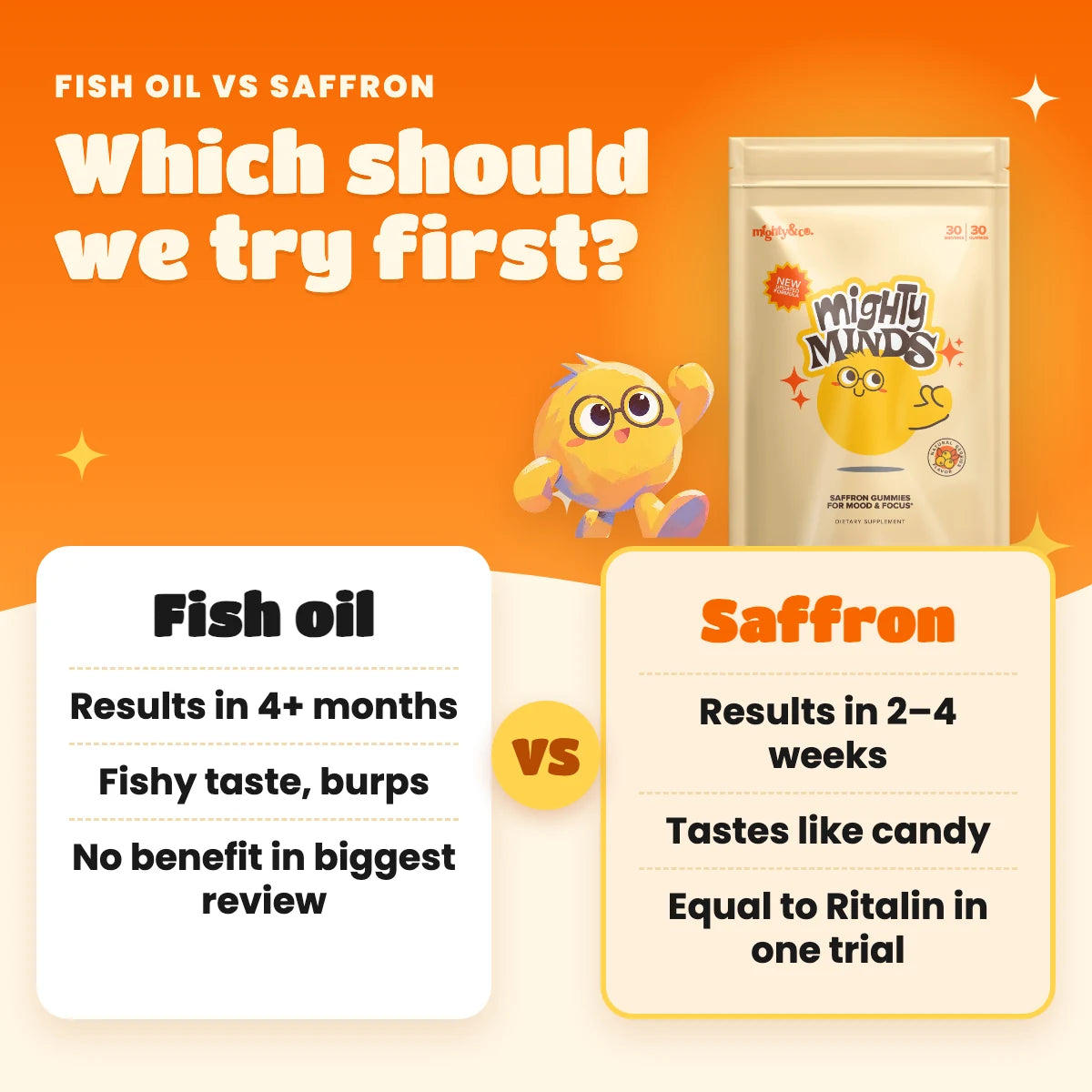
If fish oil is going to help, most studies suggest 4+ months before you'll see clear results. One review found no benefit in trials under 4 months but a small benefit in longer trials.
Compare that to saffron, where most parents see changes in 2-4 weeks.
If you've been giving your child fish oil for 6 weeks and you're not seeing improvement, it's probably not working. The research suggests patience pays off only if you commit to 4-6 months.
What about the fishy taste and burps?
This is the number one complaint about fish oil. Kids hate the taste, and the burps are awful.
Common side effects reported in studies and by parents:
- Fishy aftertaste
- Bad breath
- Fishy burps (even hours after taking it)
- Heartburn
- Nausea
- Stomach upset
- Diarrhea (at high doses)
Some brands add lemon or fruit flavoring to mask the taste. Gummies exist but they tend to have lower EPA/DHA doses than softgels. Keeping the bottle in the fridge or freezer can reduce burping.
For a lot of families, compliance is the bigger issue than effectiveness. If your child refuses to take it or gags every time, it doesn't matter what the research says.
Can saffron and omega-3 be taken together?
Yes. There are no documented interactions between saffron and fish oil or omega-3 supplements.
Some parents give both. The theory is that they work through different pathways (saffron affects dopamine, omega-3s support brain structure and inflammation), so combining them might offer broader support.
No study has tested the combination in kids, so this is parent experimentation rather than proven strategy.
Fish oil or saffron: which should we try first?
It depends on your child and what you're willing to commit to.
Try fish oil first if:
- Your child has low omega-3 intake (doesn't eat fish, avoids certain foods)
- You're willing to give it 4-6 months before deciding if it works
- Your child tolerates the taste and doesn't mind burps
Try saffron first if:
- Your child has moderate to severe ADHD symptoms and you want faster feedback (2-4 weeks instead of 4+ months)
- You want something with a clearer head-to-head comparison (saffron vs Ritalin showed equal results with fewer side effects)
- Your child won't tolerate fishy burps or taste
Try both if:
- Your child has low omega-3 levels (confirmed by testing or clear dietary gaps)
- You want to cover multiple pathways (omega-3 for brain structure, saffron for dopamine regulation)
- You're willing to give both time
Most parents who try fish oil first and see minimal results after a few months switch to saffron. Starting with saffron gives you an answer faster.
Which kids get the most out of omega-3?
The research suggests omega-3 helps most when:
1. The child has low omega-3 levels to start with
Two studies found that kids with low baseline omega-3s improved on supplements. Kids with normal levels didn't.
2. The child has inflammatory or immune issues alongside ADHD
Omega-3s reduce inflammation. If your child has eczema, asthma, allergies or frequent infections on top of ADHD symptoms, omega-3 may offer broader benefits.
3. You give it long enough
Trials under 4 months show little to no benefit. Trials over 4 months show small improvements. If you quit after 6 weeks, you probably won't see anything.
Saffron vs fish oil: what does the research show?
| Fish Oil (Omega-3) | Saffron | |
|---|---|---|
| Number of trials in kids | 37+ trials | 4 trials |
| Total participants | 2,374+ kids | ~270 kids & teens |
| Largest review conclusion | No benefit for parent-rated ADHD symptoms (Cochrane 2023) | Equal to Ritalin with fewer side effects (Baziar 2019) |
| Time to see results | 4-6 months (if it works at all) | 2-4 weeks |
| Head-to-head with medication | None | Yes (vs Ritalin) |
| Side effects | Fishy taste, burps, nausea, stomach upset | Mild stomach upset in ~10% |
| Compliance | Poor (kids hate the taste) | Good (tastes like candy) |
| Dose clarity | Varies widely (60-1,296 mg EPA/DHA) | Clear (20-30 mg extract, 0.3% safranal) |
| Who it helps most | Kids with low omega-3 levels | Kids with ADHD symptoms regardless of omega-3 status |
Fish oil has more total research but the results are weak. Saffron has less total research but the results are stronger and faster.

The bottom line
Fish oil for ADHD has been studied extensively but the results are disappointing. The largest review found no benefit for parent-rated symptoms. Smaller reviews show a tiny benefit only in trials lasting 4+ months, and mostly in kids with low omega-3 levels to start with.
Saffron has fewer trials but stronger results. In a head-to-head comparison with Ritalin, both worked equally well but saffron had far fewer side effects (13% vs 78%). Most parents see changes in 2-4 weeks instead of 4-6 months.
If your child has clear dietary omega-3 gaps (doesn't eat fish, limited diet), fish oil may be worth trying for 4-6 months. If you want faster feedback and your child has moderate ADHD symptoms, saffron is a better first choice.
You've got 60 days to try Mighty Minds risk-free. If it doesn't help, we'll refund you.
Frequently Asked Questions
No evidence suggests fish oil worsens ADHD symptoms. At worst, it does nothing. Some kids get stomach upset or fishy burps, which can make them irritable, but that's not the same as worsening ADHD.
Both are omega-3 fatty acids. EPA is more anti-inflammatory. DHA supports brain structure and development. Most fish oil contains both. Some studies suggest EPA-heavy formulas work better for ADHD, but the evidence is mixed.
Yes, if they eat fatty fish (salmon, mackerel, sardines) twice a week. Most kids don't. Flaxseed, chia and walnuts contain ALA (a different omega-3) but the body converts very little of it to EPA and DHA.
Yes. Algae oil contains DHA and EPA (fish get their omega-3s from algae anyway). It's vegan, has no fishy taste and doesn't carry the same mercury or contaminant risks as fish oil.
If you want clarity, yes. A blood test (Omega-3 Index) measures red blood cell omega-3 levels. If your child is deficient, supplementing makes sense. If levels are normal, fish oil probably won't help with ADHD.
Can fish oil make ADHD worse?
What's the difference between EPA and DHA?
Can my child get enough omega-3 from food?
Is algae-based omega-3 as good as fish oil?
Should I test my child's omega-3 levels before starting?
Published by Emma, Founder | Updated October 2026
Sources:
- Gillies D, et al. Polyunsaturated fatty acids (PUFA) for ADHD in children and adolescents. Cochrane Database Syst Rev. 2023.
- Liu JJ, et al. Omega-3 for ADHD: systematic review and meta-analysis. J Child Psychol Psychiatry. 2023.
- Huang YH, Kam WW. Omega-3 for pediatric ADHD: systematic review and meta-analysis. Nutrients. 2026.
- Chang JP, et al. Omega-3 in ADHD: benefit depends on baseline levels. Neuropsychopharmacology. 2019.
- Fu X, et al. Low omega-3 predicts response to supplementation in ADHD. J Affect Disord. 2026.
- NIH National Center for Complementary and Integrative Health. Omega-3 Supplements: In Depth. Updated 2023.
- NIH Office of Dietary Supplements. Omega-3 Fatty Acids Fact Sheet. Updated 2023.
- Australian Dietary Guidelines. Eat For Health. 2013.
- Mayo Clinic. Fish oil safety and side effects. 2023.
- Baziar S, et al. Saffron vs Methylphenidate for ADHD (for comparison). J Child Adolesc Psychopharmacol. 2019.