

Saffron vs Magnesium for Kids: Which One Helps with ADHD?
If you're trying to decide between magnesium and saffron for your child's ADHD symptoms, sleep or anxiety, the research makes it complicated. Magnesium has been studied a lot in adults but very little in kids. Saffron has clearer evidence in children but fewer total studies.
This guide breaks down what magnesium does, which form to choose, how much is safe and how it compares to saffron for focus, sleep and emotional regulation.
Does magnesium help kids with ADHD?
Maybe, but the evidence is thin and tangled with vitamin D.
Kids with ADHD tend to have lower magnesium levels than kids without ADHD. That's been confirmed in 12 studies. The question is whether giving them magnesium supplements fixes the symptoms.
The main trial that tested this gave 66 kids aged 6-12 both magnesium and vitamin D for 8 weeks. The kids were already on ADHD medication. Adding magnesium plus vitamin D improved emotional and behavior scores compared to medication alone.
The problem: you can't separate the magnesium effect from the vitamin D effect. Both were given together. No trial has tested magnesium alone for ADHD in kids.
Bottom line:
Magnesium might help kids with ADHD, especially if they're deficient. But there's no standalone magnesium-only trial to prove it.
Does magnesium help kids sleep?
There's no good evidence for this in children.
In adults, some trials show magnesium improves sleep quality. But even in adults, the reviews call the evidence weak. In kids, there are no randomized trials of magnesium for sleep.
Some parents swear by magnesium glycinate at bedtime. The theory is that magnesium relaxes muscles and supports the nervous system, making it easier to fall asleep. But that's parent observation, not published research.
If your child has sleep issues, see our melatonin guide and bedwetting guide for options with better evidence.
Which form is best: glycinate, citrate or oxide?
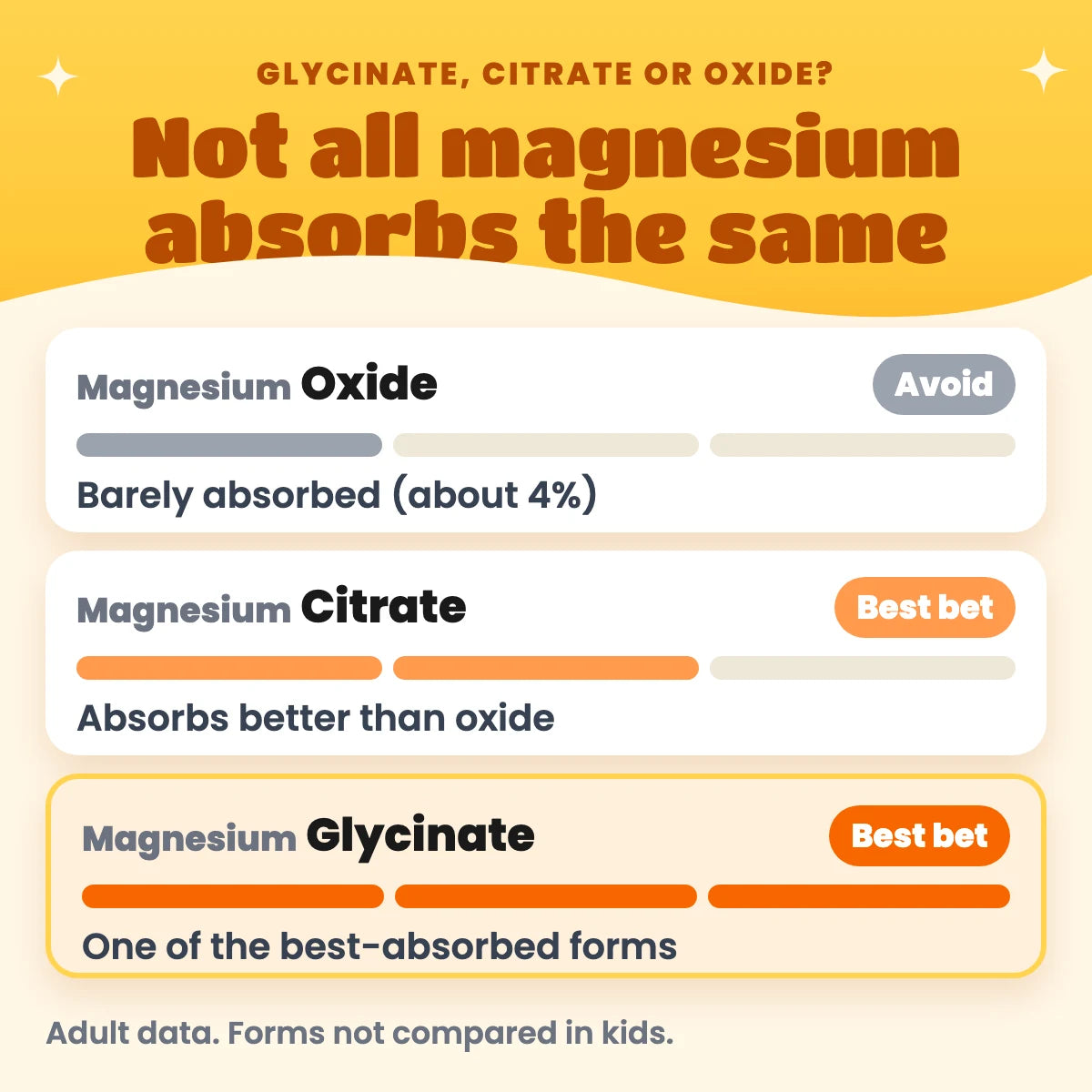
Not all magnesium is absorbed the same way.
Magnesium oxide:
Barely absorbed (about 4%). Cheap, widely available and mostly useless for getting magnesium into the body. It's the form most likely to cause diarrhea because the unabsorbed magnesium pulls water into the intestines.
Magnesium citrate:
Absorbs better than oxide. Often used as a mild laxative at high doses. At supplement doses it's fine, but some kids get loose stools.
Magnesium glycinate (or bisglycinate):
One of the best-absorbed forms. Less likely to cause diarrhea. In one small study, glycinate was "better tolerated" than other forms. This is the form most often recommended for kids.
Other forms:
Magnesium threonate, malate, taurate. These are fine but less commonly available in kids' products.
No study directly compares magnesium forms in children. The adult data suggests glycinate or citrate are your best bets. Avoid oxide.
How much magnesium is safe for my child?
Magnesium from food is always safe. Magnesium from supplements has an upper limit to avoid diarrhea.
Daily magnesium needs (RDA):
- Ages 4-8: 130 mg per day
- Ages 9-13: 240 mg per day
Upper limit from supplements (US and Australia):
- Ages 4-8: 110 mg per day
- Ages 9-13: 350 mg per day
Upper limit (EU and UK):
- Ages 4+: 250 mg per day for everyone
The first sign of too much magnesium is diarrhea. If your child gets loose stools, cut the dose in half or stop for a few days.
Here's a safe-amount table:
| Age | Daily need (RDA) | Upper limit from supplements (US/AU) | Upper limit (EU/UK) |
|---|---|---|---|
| 4-8 years | 130 mg | 110 mg | 250 mg |
| 9-13 years | 240 mg | 350 mg | 250 mg |
Sources: NIH Office of Dietary Supplements, Australian Dietary Guidelines, EFSA.
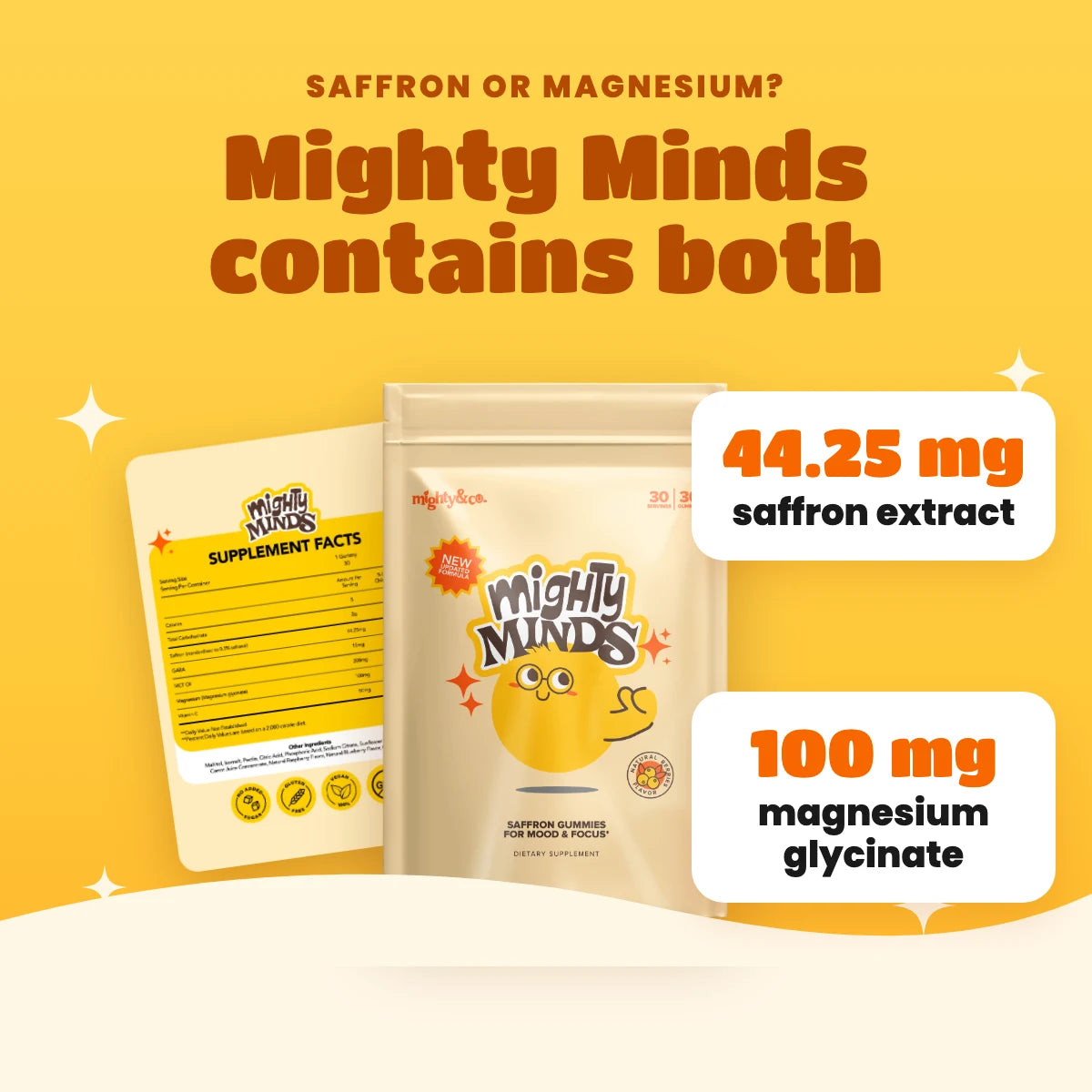
Mighty Minds contains 100 mg of magnesium glycinate per gummy, well within safe limits for kids aged 4+.
Can saffron and magnesium be taken together?
Yes. There are no documented interactions between saffron and magnesium.
Some parents give both. The idea is that magnesium supports the nervous system and muscle relaxation while saffron supports dopamine regulation. Different pathways, potentially complementary.
No study has tested the combination in kids, so this is trial and error.
Saffron or magnesium: which first?
It depends on what you're trying to fix and how clear the evidence needs to be.
Try magnesium first if:
- Your child has clear signs of low magnesium (muscle cramps, twitching, restless legs)
- You want the simplest, cheapest option with the least risk
- Sleep is the main issue (though evidence is weak)
Try saffron first if:
- ADHD symptoms (focus, emotional regulation, impulsivity) are the main concern
- You want something with head-to-head research vs medication
- You want faster feedback (2-4 weeks instead of months)
Try both if:
- You want to cover nervous system support (magnesium) and dopamine regulation (saffron)
- Your child has ADHD plus sleep or muscle tension issues
Most parents who try magnesium alone for ADHD see modest improvements at best. Saffron has clearer results in the research.
Magnesium vs saffron: what does the research show?
| Magnesium | Saffron | |
|---|---|---|
| Trials in kids for ADHD | 1 (combined with vitamin D) | 4 |
| Participants | 66 kids | ~270 kids & teens |
| Standalone magnesium evidence | None (always tested with vitamin D or other nutrients) | Yes (4 trials) |
| Head-to-head with medication | No | Yes (vs Ritalin, equal results) |
| Time to see results | Unknown (most trials 8-12 weeks) | 2-4 weeks |
| Evidence for sleep in kids | Weak to none | Not studied for sleep specifically |
| Side effects | Diarrhea at high doses | Mild stomach upset in ~10% |
| Compliance | Easy (powder, gummies, tablets) | Easy (gummy tastes like candy) |
| Safe upper limit (ages 4-8) | 110 mg/day from supplements (US/AU) | No established limit, studied up to 30 mg extract |
Magnesium is safe and cheap but the ADHD evidence in kids is weak. Saffron has stronger, clearer results for focus and behavior.

The bottom line
Magnesium might help kids with ADHD, especially if they're deficient. But the main trial tested magnesium plus vitamin D together, so you can't isolate magnesium's effect. There's no good evidence for magnesium helping kids sleep.
The best-absorbed forms are glycinate and citrate. Avoid oxide. Safe upper limits are 110 mg per day (ages 4-8) and 350 mg per day (ages 9-13) from supplements in the US and Australia.
Saffron has clearer evidence for ADHD in kids. Four trials, 270 participants, including a head-to-head comparison with Ritalin showing equal results with far fewer side effects.
If you want the simplest option and suspect low magnesium, try magnesium glycinate. If you want something with stronger ADHD evidence and faster results, try saffron.
Mighty Minds contains both: 44.25 mg saffron extract (0.3% safranal) and 100 mg magnesium glycinate per gummy.
Frequently Asked Questions
No. Magnesium is calming, not stimulating. At worst, it does nothing for ADHD symptoms. Too much can cause diarrhea but that's the only common downside.
Dark leafy greens (spinach, kale), nuts (almonds, cashews), seeds (pumpkin, sunflower), whole grains, beans, avocado, dark chocolate. Most kids don't eat enough of these, which is why low magnesium is common.
Magnesium doesn't interact with ADHD stimulants (Ritalin, Adderall, Concerta). One trial added magnesium on top of medication without issues. Always tell your doctor what supplements your child is taking.
Mighty Minds isn't a sleep aid. It's a morning gummy for focus and emotional regulation. Some parents report better sleep as a side effect of improved calm during the day, but it doesn't contain melatonin or high-dose magnesium.
If you're giving it for sleep (even though evidence is weak), give it 30-60 minutes before bed. If you're giving it for general health or ADHD support, morning or evening both work. Consistency matters more than timing.
Can magnesium make ADHD worse?
What foods have magnesium?
Can my child take magnesium with ADHD medication?
Does Mighty Minds help with sleep?
Should I give magnesium at night or in the morning?
Published by Emma, Founder | Updated October 2026
Sources:
- NIH Office of Dietary Supplements. Magnesium Fact Sheet for Health Professionals. Updated 2023.
- Australian Dietary Guidelines. Nutrient Reference Values: Magnesium. 2013.
- EFSA. Tolerable Upper Intake Levels for Vitamins and Minerals. 2006.
- Huang YH, et al. Magnesium levels in children with ADHD: meta-analysis. Neuropsychiatr Dis Treat. 2019.
- Hemamy M, et al. Magnesium and vitamin D co-supplementation in children with ADHD. Nutr Neurosci. 2021.
- Firoz M, Graber M. Bioavailability of US commercial magnesium preparations. Magnes Res. 2001.
- Walker AF, et al. Mg citrate found more bioavailable than other Mg preparations. Magnes Res. 2003.
- Schuette SA, et al. Tolerability and absorption of magnesium supplements. Am J Clin Nutr. 1994.
- Mah J, Pitre T. Oral magnesium supplementation for insomnia in adults. J Gen Intern Med. 2021.
- Lopresti AL. Magnesium and sleep: systematic review. Nutrients. 2026.